
Entertainment
The Quarantined Release ‘Aversion To Normalcy,’ An Album Born From War and Survival

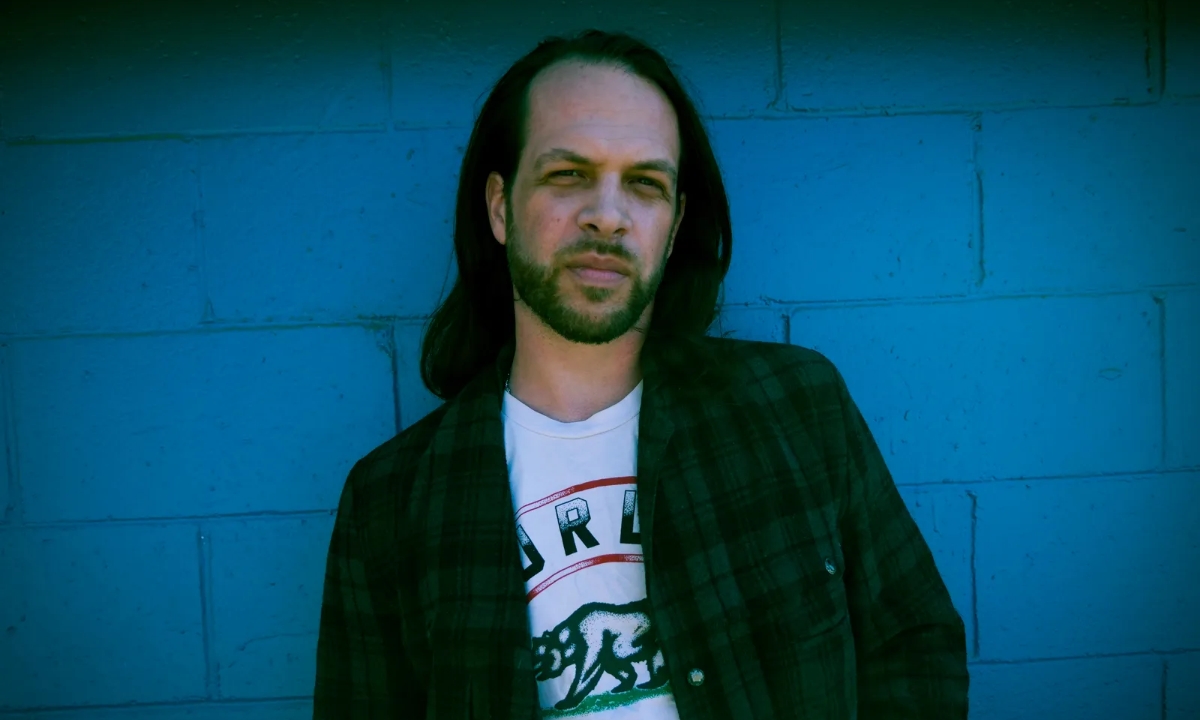
The Quarantined are released their third studio EP, “Aversion to Normalcy,” today, and it’s not the kind of record you put on for background music. Created by Sean Martin, a former airborne infantryman and Iraq War veteran, the album confronts trauma head-on, pulling from his experiences in combat and the disorienting aftermath of trying to rebuild a life once you’re home. It’s grunge-heavy, emotionally direct, and built around the idea that “normal” is just a polite lie we tell ourselves. What makes it work is that Martin isn’t trying to package his experience into something digestible. He’s just refusing to look away.
The album arrives with momentum that’s hard to ignore. The Quarantined have racked up over 30 million views across TikTok, with one clip of “Skeleton Chair” alone hitting 1.1 million+ views. On Spotify, they’ve pulled in 500,000 streams, and their viral reach has sparked conversations about trauma, forgiveness, and what it actually means to heal. For a band working outside the traditional industry machine, those numbers say something about how their message is connecting.

Martin doesn’t soften his subject matter. Tracks like “Skeleton Chair,” “Shadow (on my back),” and “Nemesis (friend of mine)” trace a path through chaos, self-destruction, and the slow, unglamorous work of choosing to survive. He’s not writing from a place of having figured it all out. He’s writing from the middle of it, which is what makes the record feel urgent rather than reflective. There’s no tidy resolution here, just the raw acknowledgment that some battles don’t end when you come home.
The album was recorded at Blackbird Studios and Sound Emporium in Nashville, two facilities known for handling heavyweight rock projects. Producer Nathan Yarborough, who’s worked with Alice in Chains, Korn, Halestorm, and Evanescence, handled engineering and production. The lineup includes Jerry Roe on drums, Luis Espalliat on bass, and Zack Rapp from Dream Theater on lead guitar and violins, with Martin covering vocals and guitar. It’s a setup that balances aggression with precision, letting the songs hit hard without losing their emotional core.
In a Veterans Day post on Facebook, Martin didn’t hold back about what this album means and what it cost. “You know, the things you thank us for today, have lifetime consequences for those who carry the burden,” he wrote. “I always thought if you’re gonna thank someone, better be specific about what and why, otherwise it has no meaning except as a false absolution for yourself.” It’s a pointed critique of performative gratitude, and it underscores what “Aversion to Normalcy” is actually about: rejecting easy answers and comfortable narratives in favor of something messier and more honest.
Martin pulls from punk rock, grunge, and metal, but what ties it together is his refusal to romanticize any of it. This isn’t protest music in the traditional sense. There are no slogans, no clear villains. Instead, it’s an invitation to sit with discomfort, to look at the parts of life that don’t fit into neat categories, and to find meaning in survival itself.
The Quarantined also support the Free2Luv movement, working on anti-bullying efforts, mental health advocacy, and music education for veterans and their families. It tracks with what the album’s already doing: making room for people who are still figuring it out, still fighting through it.
“Aversion to Normalcy” doesn’t offer answers. It offers witness, which might be more valuable anyway. In a culture that constantly demands we move on, heal up, and get back to normal, Martin’s album asks a better question: what if normal was never the goal in the first place?
“Aversion to Normalcy” is available now on all streaming platforms. You can follow The Quarantined on TikTok, Instagram, and Facebook at @thequarantined, visit their website here, or stream their projects on Spotify.






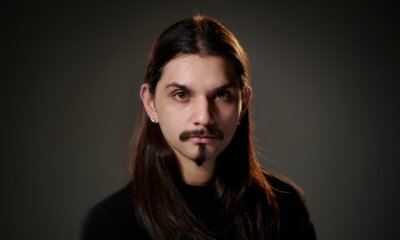


Breaking into the entertainment industry is hard enough when you grow up surrounded by it. Try doing it from Lima, Peru, where the path to international work isn’t something anyone hands you. That’s the reality Diego Esquives started from, and it’s exactly why his trajectory is worth paying attention to.
Esquives trained at Asociación Cultural Diez Talentos in Lima and later at The American Musical Dramatic Academy in Los Angeles, but the interesting part of his career isn’t where he studied. It’s what he did with it. His early stage work in Peru, including productions of “Macbeth” and “Hamlet” and a gripping turn as The Creature in “Frankenstein,” earned him Best Actor nominations at the Luces Awards. For a Peruvian actor with international ambitions, those classical roles weren’t just credits. They were proof he could go toe to toe with material that intimidates most performers regardless of where they’re from.
That foundation shows up across his film work in ways that separate him from the pack. Take “Mistakes,” where Esquives plays Roman, an underground power player who orders a hit that goes sideways when his own sister gets killed. It’s a dark premise that could easily tip into melodrama, but Esquives keeps it grounded. The film earned finalist status at the London Film Club and screened at The Flight Deck Film Festival and Lift-Off Sessions. He also handled stunt coordination on the project, which tells you something about how hands-on he is with every aspect of production.

Then there’s the other side of Esquives, the filmmaker who clearly can’t sit still. His directorial work started in 2023 with the stage production “The Last Christmas Tree,” but he moved quickly into film with The Immigrants, a short he also wrote and produced. In the film, he plays Nacho, one of two cousins arguing over the path forward as immigrants searching for a better life. It’s a story that hits close to home for Esquives, and festival audiences took notice. The project picked up nominations for Best Film at both The Americas Film Festival New York and the Wolf Media Festival, and screened at festivals including Indie Film Los Angeles and the Los Angeles Lift-Off Film Festival.

Esquives also took the stage in “Water by the Spoonful” and brought “The Last Christmas Tree” and “Dreamers” to The L.A. Brisk Festival in 2024, pushing his work in front of new audiences and continuing to build an international presence that stretches well beyond Peru.
Look at his 2025 credits and you’ll see someone operating at a completely different speed. He directed and produced “Three Stories,” a short where he also plays three separate characters. He wrote, directed, and starred in “All Night Long.” He acted in “Caged Voices.” He even handled production design and set decoration on “Eve.” That range of involvement across multiple projects in a single year isn’t common, especially for a Peruvian actor carving out space in an industry that doesn’t always make room for Latino creators.

That’s really the point with Esquives. He’s not waiting for the industry to notice him or hoping someone opens a door. He’s building his own projects, wearing every hat on set, and doing it all while representing a community that rarely gets this kind of international visibility.
His next project, a film called “International Actor,” sounds like it might be the most autobiographical thing he’s done yet. For someone who left Peru determined to put Latino talent on the global map, the title fits perfectly.
You can follow his upcoming projects on Instagram or browse his full credits on IMDb.

There’s something inherently stubborn about an artist who spends nearly three decades making music almost entirely on his own terms. Marco De Luca, an Italian singer-songwriter from the small town of Atri in the province of Teramo, has been doing exactly that since the 1990s. His latest album, LA STAGIONE DECISIVA, is the sharpest, most keyboard-driven work he’s ever put together, and it doubles as a pointed critique of the darker corners of modern society.
De Luca’s story starts with Sine, a group he fronted in the ’90s while channeling his deep admiration for The Cure through original material and covers. When the band split at the turn of the millennium, he didn’t chase another lineup. Instead, he pulled back from live performance and disappeared into songwriting. The result was 2006’s STANZE REMOTE, a self-produced experimental album soaked in ’80s new wave influence, built entirely in his home studio. Two years later, the EP DUE brought in outside musicians for a more collaborative, pop-leaning sound that picked up airplay on several radio stations. Then came 2012’s Canzoni Inedite, a collection of songs written across different periods that leaned closer to the Italian singer-songwriter tradition.
Each release shifted direction just enough to keep things unpredictable. LA STAGIONE DECISIVA continues that pattern. Across eight tracks, De Luca leans harder into keyboards and synth work than anything he’s done before, threading Synthwave textures and electronic layers through a foundation of alt-rock guitars and vocal harmonies. His influences tell the story pretty clearly. The Cure, The Smashing Pumpkins, David Bowie, New Order, Radiohead, and Franco Battiato all left their fingerprints on his approach, and this album feels like the first time he’s managed to fold all of them into the same room. He wrote, arranged, and recorded the entire album himself in a studio, which at this point feels less like a creative choice and more like the only way he knows how to work.

What gives the album its weight isn’t just the production. It’s the subject matter. De Luca has described LA STAGIONE DECISIVA as a protest record, and the targets are specific: racism, social marginalization, exploitative television, prostitution, war. Three of the eight tracks, “VIDEOSPAZZATURA,” “IL MOSTRO,” and “UN UOMO GENTILE,” are reworked versions of songs from his Sine days, rearranged to fit alongside five new compositions. The fact that protest songs he wrote over two decades ago still feel relevant says something uncomfortable about how little has actually changed.
The album opens with “VIDEOSPAZZATURA,” where layered vocal harmonies hit hard right out of the gate. Smashing guitar riffs and a driving rhythm section give the track real urgency, and the repeated chorus works like a hook you can’t shake. It’s confrontational in the best way. “IL MOSTRO” follows with distorted guitars and solid synth lines tangled together over a stomping bass and drum groove. De Luca’s vocals walk a line between melodic and forceful, balancing aggression with clarity that keeps the emotional core intact.
The record’s quieter moments are just as effective. “LA FESTA” strips things back to a slow drum pattern, minimal bass, and warm synth textures. De Luca’s vocal delivery here is genuine and unguarded as he sings about a sad child wandering through a celebration, and the arrangement gives the lyrics room to land. It’s one of the album’s most personal tracks, and it reveals his strengths as a storyteller more than anything else on the record.
“ALLA DERIVA” pushes into more experimental territory with layered harmonies and electronic textures that twist and shift without losing cohesion. “15 ANNI” takes a nostalgic turn, built around heavy synth vibes and a chorus that cuts deep with longing. “UN UOMO GENTILE” brings back the alt-rock intensity with surrounding synth atmospheres and prominent vocal echoes that add real depth. “ASPIRANTI MODELLE” continues exploring societal contradictions through warm arrangements and compelling melodic lines, while closer “IL GIORNO” fuses everything together into something that genuinely feels like end credits rolling on a film. For the last track on the record, it fits perfectly.
Even the album cover tells a story. It features a grainy, high-contrast black-and-white photo of a vintage youth football team posed on a dirt pitch, evoking a kind of mid-century nostalgia that contrasts sharply with the record’s contemporary themes. It’s a small detail, but it reinforces the album’s tension between looking back and confronting the present.
What holds all of it together is De Luca’s refusal to settle into one mode. The album moves between dark and melodic, experimental and accessible, personal and political, without ever feeling scattered. Every synth layer, every guitar texture, every arrangement choice feels intentional. For someone who’s spent most of his career working independently from a small Italian town, the level of passion here is hard to ignore.
LA STAGIONE DECISIVA is available to stream on SoundCloud and can be downloaded on Bandcamp. You can follow Marco De Luca on Facebook, X, and Instagram.
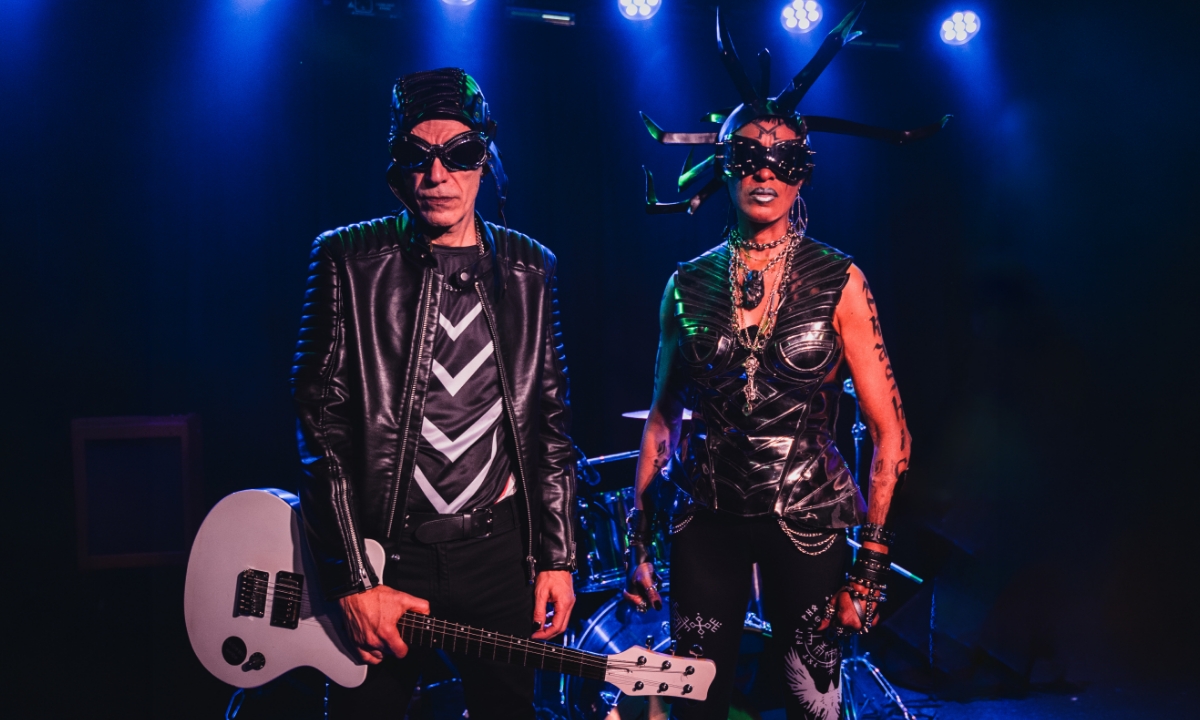
There’s a moment early in the official music video for “Karmic Justice” where AKASHIC GODS stands framed in deep red light, spiked headpiece catching the shadows, and the whole thing feels less like a music video and more like a warning. That’s not an accident. The clip, which drops today alongside the single itself, is the kind of visual statement that makes you forget to think about the song for a minute because you’re too busy trying to figure out what you’re actually looking at.
That’s the point.
AKASHIC GODS has built her current incarnation around the idea that image and sound are inseparable, and “Karmic Justice” makes the strongest case yet for that philosophy. The official music video runs exactly 3:33 and packs enough visual information into that runtime to sustain a full art-direction breakdown. It’s shot primarily in studio but the atmosphere it builds feels anything but contained.
The aesthetic pulls from a lot of directions at once, which is what makes it interesting rather than chaotic. The styling on AKASHIC GODS herself is the first thing that lands. A spiked headpiece that reads somewhere between high-fashion editorial and ancient ritual object sits above black leather that carries a futuristic edge with unmistakable tribal undertones. It’s the kind of look that shouldn’t cohere as neatly as it does, but there’s a commitment to the concept that makes it work. Grace Jones built her whole career on that same collision of the futuristic and the ancient, commanding imagery that felt simultaneously from another century and far ahead of it. AKASHIC GODS is clearly operating in that same territory.
The color palette does a lot of the heavy lifting throughout. Deep reds, greens, and blacks dominate, and the production team uses them with real intentionality. Red signals consequence. Black grounds everything in weight and finality. The greens introduce something colder, almost otherworldly, cutting through the warmth of the reds to keep things from ever feeling too comfortable. It’s a mood built through color rather than stated through lyrics, which is the kind of visual restraint that marks someone who actually understands what a music video can do beyond just being a performance clip.
The imagery between performance shots is where the video earns its “conceptual” label without being pretentious about it. Statues. Crosses. Tornadoes. Figures wearing samurai-style masks. None of it is explained, and that’s entirely the right call. The track is about karma, betrayal, and the certainty that consequences are coming for the people who deserve them. Those images don’t illustrate those themes so much as they amplify them, giving the viewer’s brain something to chew on while the performance commands the center. The samurai masks in particular carry a dual weight, both armor and ritual, which fits the song’s core proposition: that AKASHIC GODS isn’t just hurting, she’s protected.
The editing style reinforces all of it. Fast cuts and digital glitch effects run throughout, cut to match the track’s industrial edge. Glitch editing can feel like a lazy shortcut when it’s applied without thought, but here it functions as a kind of emotional punctuation. The distortions hit when the intensity spikes, which keeps the technique feeling purposeful rather than decorative.
What the video ultimately constructs is a visual mythology. AKASHIC GODS isn’t presenting herself as just another artist processing a breakup. The imagery positions her as something closer to a figure operating at the intersection of the spiritual and the physical, someone who has moved through emotional devastation and emerged with something harder and more certain on the other side. The iconography does that work without anyone having to say it directly.
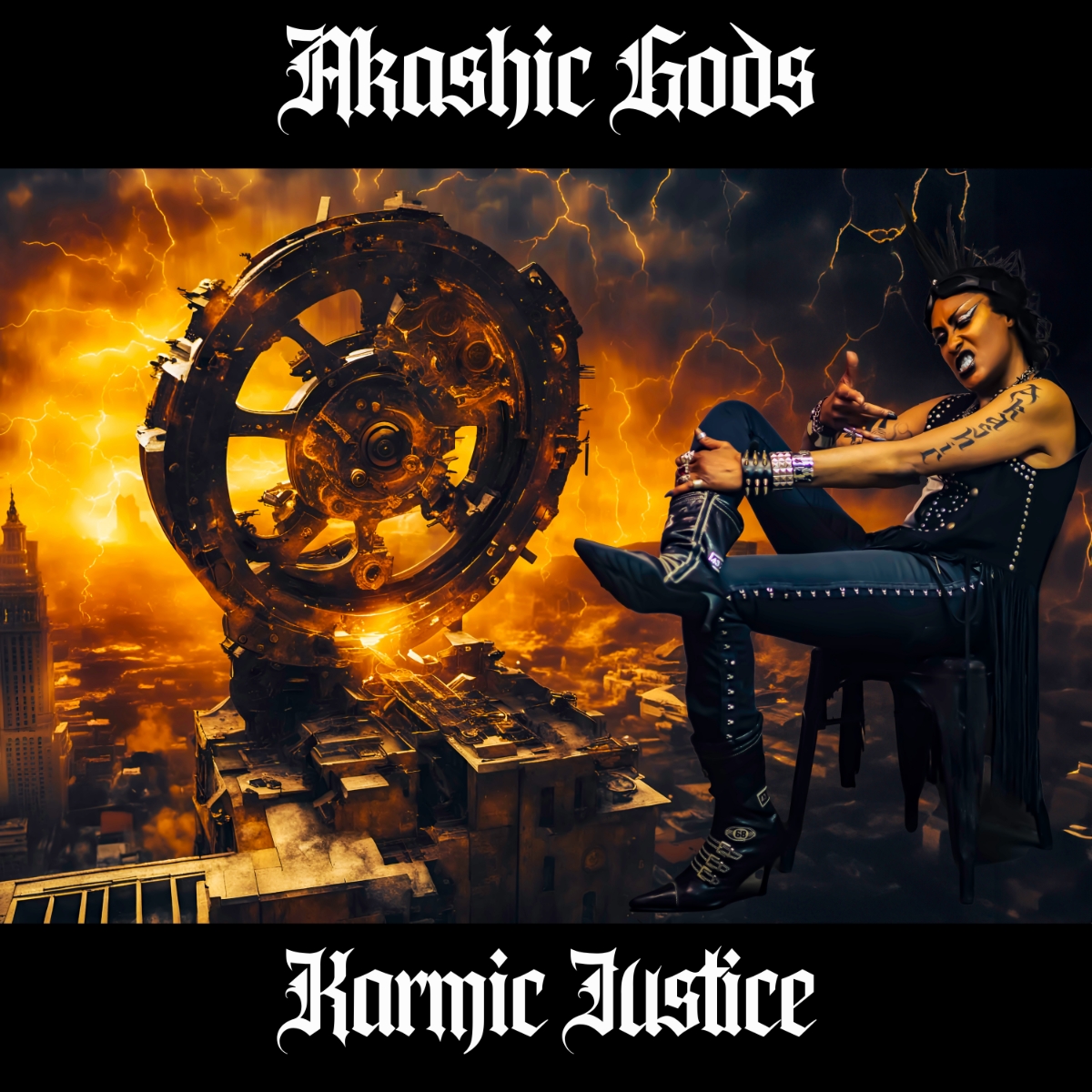
“Karmic Justice” is AKASHIC GODS’ third single and the most recent preview of her forthcoming album “Gods and Machines,” produced by Carlone Lewis. The buzz around it was already building before today’s release. In January 2026, AKASHIC GODS was interviewed at the UK film premiere of the sci-fi film “Dream Hacker,” directed by Richard Colton and Tony Fadil, speaking about the single ahead of its drop. That kind of crossover attention speaks to where the project sits right now. The single is mastered by Andy Baldwin at Metropolis Studios, with the video produced through Asmara Studios. For a project that’s described itself as sitting at the meeting point of celestial themes and raw human experience, the video lands exactly where it’s supposed to.
The clip closes with a QR code pointing viewers to her Instagram, @AKASHIC_GODS, which is a smart move. What someone who just watched this video needs isn’t a streaming link. They need more of the world. You can also follow AKASHIC GODS on Facebook, TikTok, and X, or catch up on the full story of her artistic evolution in this press feature on Just News International.
Whatever “Gods and Machines” ends up being, “Karmic Justice” makes a solid argument that the visuals are going to be as worth watching as anything else about it.


How Diego Esquives Is Taking Peruvian Talent to the International Stage

LA STAGIONE DECISIVA Is Marco De Luca’s Most Ambitious Record Yet
Marco De Luca’s LA STAGIONE DECISIVA Is a One-Man Protest Album Built on Decades of Restless Experimentation

The Visual Language of ‘Karmic Justice’ Puts AKASHIC GODS in a Category of Her Own

Niraj Nair and Mark Chan Keep Finding the Grief Underneath the Bravado

Milovay Is Done Starting Over and Just Getting Started

Andre Correa’s New Single “Histórias” Explores How Stories Change in the Telling

Miixed Realities Proves Medical Billing Doesn’t Have to Be a Black Hole

Meet Lil Deezull, the Cambridge Rapper Finding His Moment

Dennis Dewall Reboards the Spy Genre with International Thriller ‘THE TRAIN’

Saynt Ego on Grief, Mental Health, and Learning to Sit With the Noise

Marloma Talks Learning to Stop Writing in Isolation and Trust the Chaos

Zizzo World Is Building Momentum That’s Hard to Ignore

Yash Kapoor Wants His Records To Feel Like Moments, Not Just Music

Inside the Amazon Reinstatement Process: The aSellingSecrets Approach

Jason Luv Dominates Charts While Inspiring New Wave of Multi Career Artists

Harley West | Inside the Mind of a Social Media Star on the Rise

Raw Fishing | Franklin Seeber, Known As “Raww Fishing” Youtuber Story

Jordana Lajoie Transforms Montreal Roots into Hollywood Success Story

A New Hollywood Icon Emerges in Madelyn Cline

Who is Isaiah Silva – The Story Behind The Music

Tefi Valenzuela Pours Her Heart into New Song About Breaking Free

Gearshift to Stardom: Nikhael Neil’s Revolutionary Journey in the Automotive Industry

Kaia Ra | Perseverance That Built a Best-Selling Author

G FACE Releases His New Single “All up,” and It’s Fire

Holly Valentine | Social Media Influencer & Star Success Story

Kate Katzman | Breaking Into Hollywood and Embracing Change

Thara Prashad | Singer Evolves to Yoga & Mediation Superstar

Tadgh Walsh – How This Young Entrepreneur is Making a Name for Himself

King Lil G | West Coast Hip Hop Genius Rises to Face With Ease
Tefi Valenzuela Pours Her Heart into New Song About Breaking Free
Kate Katzman | Breaking Into Hollywood and Embracing Change
Holly Valentine | Social Media Influencer & Star Success Story
Kaia Ra | Perseverance That Built a Best-Selling Author

Lil Ugly Baby XXX’s “Who?” – The Mixtape to Boost Your Playlist

Samuel Chewning Explains How Fitness Should Be A Personal Journey

-
 Business4 years ago
Jason Luv Dominates Charts While Inspiring New Wave of Multi Career Artists
-
 Entertainment3 years ago
Harley West | Inside the Mind of a Social Media Star on the Rise
-
 Culture4 years ago
Raw Fishing | Franklin Seeber, Known As “Raww Fishing” Youtuber Story
-
 Culture3 years ago
Jordana Lajoie Transforms Montreal Roots into Hollywood Success Story
-
 Culture2 years ago
A New Hollywood Icon Emerges in Madelyn Cline
-
 Entertainment1 year ago
Who is Isaiah Silva – The Story Behind The Music
-
 Entertainment3 years ago
Tefi Valenzuela Pours Her Heart into New Song About Breaking Free
-
 Business3 years ago
Gearshift to Stardom: Nikhael Neil’s Revolutionary Journey in the Automotive Industry