
Entertainment
The Visual Language of ‘Karmic Justice’ Puts AKASHIC GODS in a Category of Her Own


There’s a moment early in the official music video for “Karmic Justice” where AKASHIC GODS stands framed in deep red light, spiked headpiece catching the shadows, and the whole thing feels less like a music video and more like a warning. That’s not an accident. The clip, which drops today alongside the single itself, is the kind of visual statement that makes you forget to think about the song for a minute because you’re too busy trying to figure out what you’re actually looking at.
That’s the point.
AKASHIC GODS has built her current incarnation around the idea that image and sound are inseparable, and “Karmic Justice” makes the strongest case yet for that philosophy. The official music video runs exactly 3:33 and packs enough visual information into that runtime to sustain a full art-direction breakdown. It’s shot primarily in studio but the atmosphere it builds feels anything but contained.
The aesthetic pulls from a lot of directions at once, which is what makes it interesting rather than chaotic. The styling on AKASHIC GODS herself is the first thing that lands. A spiked headpiece that reads somewhere between high-fashion editorial and ancient ritual object sits above black leather that carries a futuristic edge with unmistakable tribal undertones. It’s the kind of look that shouldn’t cohere as neatly as it does, but there’s a commitment to the concept that makes it work. Grace Jones built her whole career on that same collision of the futuristic and the ancient, commanding imagery that felt simultaneously from another century and far ahead of it. AKASHIC GODS is clearly operating in that same territory.
The color palette does a lot of the heavy lifting throughout. Deep reds, greens, and blacks dominate, and the production team uses them with real intentionality. Red signals consequence. Black grounds everything in weight and finality. The greens introduce something colder, almost otherworldly, cutting through the warmth of the reds to keep things from ever feeling too comfortable. It’s a mood built through color rather than stated through lyrics, which is the kind of visual restraint that marks someone who actually understands what a music video can do beyond just being a performance clip.
The imagery between performance shots is where the video earns its “conceptual” label without being pretentious about it. Statues. Crosses. Tornadoes. Figures wearing samurai-style masks. None of it is explained, and that’s entirely the right call. The track is about karma, betrayal, and the certainty that consequences are coming for the people who deserve them. Those images don’t illustrate those themes so much as they amplify them, giving the viewer’s brain something to chew on while the performance commands the center. The samurai masks in particular carry a dual weight, both armor and ritual, which fits the song’s core proposition: that AKASHIC GODS isn’t just hurting, she’s protected.
The editing style reinforces all of it. Fast cuts and digital glitch effects run throughout, cut to match the track’s industrial edge. Glitch editing can feel like a lazy shortcut when it’s applied without thought, but here it functions as a kind of emotional punctuation. The distortions hit when the intensity spikes, which keeps the technique feeling purposeful rather than decorative.
What the video ultimately constructs is a visual mythology. AKASHIC GODS isn’t presenting herself as just another artist processing a breakup. The imagery positions her as something closer to a figure operating at the intersection of the spiritual and the physical, someone who has moved through emotional devastation and emerged with something harder and more certain on the other side. The iconography does that work without anyone having to say it directly.

“Karmic Justice” is AKASHIC GODS’ third single and the most recent preview of her forthcoming album “Gods and Machines,” produced by Carlone Lewis. The buzz around it was already building before today’s release. In January 2026, AKASHIC GODS was interviewed at the UK film premiere of the sci-fi film “Dream Hacker,” directed by Richard Colton and Tony Fadil, speaking about the single ahead of its drop. That kind of crossover attention speaks to where the project sits right now. The single is mastered by Andy Baldwin at Metropolis Studios, with the video produced through Asmara Studios. For a project that’s described itself as sitting at the meeting point of celestial themes and raw human experience, the video lands exactly where it’s supposed to.
The clip closes with a QR code pointing viewers to her Instagram, @AKASHIC_GODS, which is a smart move. What someone who just watched this video needs isn’t a streaming link. They need more of the world. You can also follow AKASHIC GODS on Facebook, TikTok, and X, or catch up on the full story of her artistic evolution in this press feature on Just News International.
Whatever “Gods and Machines” ends up being, “Karmic Justice” makes a solid argument that the visuals are going to be as worth watching as anything else about it.
You can stream “Karmic Justice” right now on Spotify, Apple Music, Amazon Music, and Deezer.










When Christian pop artist Vanessa Béjine stepped onto the red carpet at the 2026 Hollywood Independent Music Awards, she arrived as a nominee. What she didn’t know was that the story of the night would continue well beyond the ceremony.
Dressed in an unforgettable blue custom-tailored Versace gown, Béjine completed the look with gold Versace heels, and a matching handbag. She attended the ceremony with co-producer Eleni Thompson, celebrating the nomination of her single Help Me Help Them in the Christian/Gospel category.
Another entry was mistakenly announced as the winner. Then came an unexpected development. Following the ceremony, it was discovered that the song originally awarded the honor was completely AI-generated. The original result was subsequently voided, and HIMA apologized and awarded Best Christian Song to Béjine for Help Me Help Them.
For an artist whose work is rooted heavily in lived experience, the circumstances surrounding the win made the recognition particularly meaningful.
Music Made From Real Life
Béjine believes the relationship between an artist and listener is built on something technology cannot manufacture: shared human experience. Her songs often begin with things she has lived through, witnessed or deeply cared about — faith, loneliness, perseverance, injustice and the decision to keep going through seasons that don’t make sense.
It’s also why Béjine holds a firm position on AI-generated music. While artificial intelligence has become increasingly present across entertainment, she believes music itself should remain a human art form. To Béjine, listeners don’t simply connect with a melody. They connect with the person behind it. A song about heartbreak carries weight because someone has experienced heartbreak. A song about faith can resonate because someone has wrestled with doubt, waited for an answer or found the strength to keep believing.
Music, in her view, is not simply an end product. It is an art form shaped by human talent, creativity, emotion and experience. There is a fundamental difference between an artist creating a song and someone prompting a computer system to generate one — particularly when the two are placed in competition for recognition of artistic achievement.
That philosophy is woven throughout Help Me Help Them.

A Song Rooted in Compassion
At its core, Help Me Help Them is about compassion. The song gives a voice to those who are easily overlooked — including people experiencing hardship, abandoned children and animals waiting for someone to notice them. Its message acknowledges an uncomfortable reality: no individual can save everyone. But everyone can help someone.
That simple idea captures much of what Béjine wants her music to accomplish. For her, success isn’t only about being heard. It’s about creating something honest enough that another person can hear their own experience reflected back to them — and perhaps feel a little less alone because of it.
The Long Game of an Independent Artist
The HIMA win represents another step forward for an artist who has continued building her career independently. Béjine has developed a sound that crosses contemporary Christian pop, dance, R&B-pop and cinematic influences, allowing individual songs to take on different identities while maintaining the same foundation: faith and honest storytelling.
There is also something fitting about the way this particular award arrived. The recognition came only after the initial result was revisited and corrected. HIMA’s decision ultimately ensured that an award intended to recognize artists and their creative work went to an eligible human artist — an important distinction as the music industry continues confronting questions surrounding artificial intelligence and creative ownership.
For Béjine, the moment isn’t about diminishing the awards organization that ultimately corrected the result. Nor is it simply about opposition to a new technology. It’s about protecting something she believes is worth preserving: the human talent, artistry and human connection with listeners at the center of music. Songs have historically allowed people separated by geography, background and circumstance to recognize themselves in someone else’s story. That connection begins with a human being having something to say.
And as Béjine continues building her catalog and reaching new listeners, Help Me Help Them now carries another distinction with it: Best Christian Song. For an artist whose music has always centered on faith, resilience and giving a voice to those who need one, it’s a recognition that feels especially fitting.
Entertainment
AKASHIC GODS Shatters Digital Hypnosis with an Arena-Sized Spiritual Awakening on ‘The Ether Element’

“Orphans of wisdom” is the kind of phrase that either lands or it doesn’t, and AKASHIC GODS has built an entire album around making it land. The line names the fourth track on The Ether Element, the concept record the one-woman project releases this August, and it describes how the artist sees a culture that is, in her words, “information proud” yet starving for truth. The album’s thesis is simple enough to fit on a placard. Its execution takes ten tracks and a lot of distortion.
Akashic Gods came up somewhere else entirely. Her earlier work sat in dance music, drawing support from DJs including David Guetta and Fatboy Slim, before the project as it exists now took shape in 2024. The three singles released ahead of the album have performed well on independent radio, with “Karmic Justice” holding No. 1 on the independent airplay charts for four consecutive weeks and “Weapons in Space” spending three weeks at No. 1 on the UK Talk Radio Hot 100. “Gods and Machines,” her first single under the name, reached No. 2, picked up international airplay and was featured on a national television music show in Norway. Away from radio, she was interviewed on the red carpet at the UK film premiere of Dream Hacker earlier this year and turned up as a guest on the Martin Talk Show podcast.
That track opens the record and sets its terms. “Gods and Machines” pits ancient religious imagery against automated modern life, and the artist describes it as a warning against trading a soul for the illusions of the digital age. The phrase driving the song is “mindless express,” and the rhythm track was built to match it, rigid and unstoppable, a train nobody gets to step off. The song’s official music video which stands as the essential doorway into the album’s sonic landscape.
The production leans into the same opposition. Working with producer Carlone Lewis, AKASHIC GODS set glitchy industrial synths and stiff electronic programming against warm orchestral strings and stacked, choir-like vocal harmonies. The stated aim was to make cold machinery and human voice fight over the same space in the mix. The record is built in two movements, The System, described as the weight of modern manipulation, technology and betrayal, and The Sanctuary, described as the awakening of the human spirit through divine justice and forgiveness. Whether that reads as a smart structural idea or a heavy-handed one, the method matches what the songs are saying.
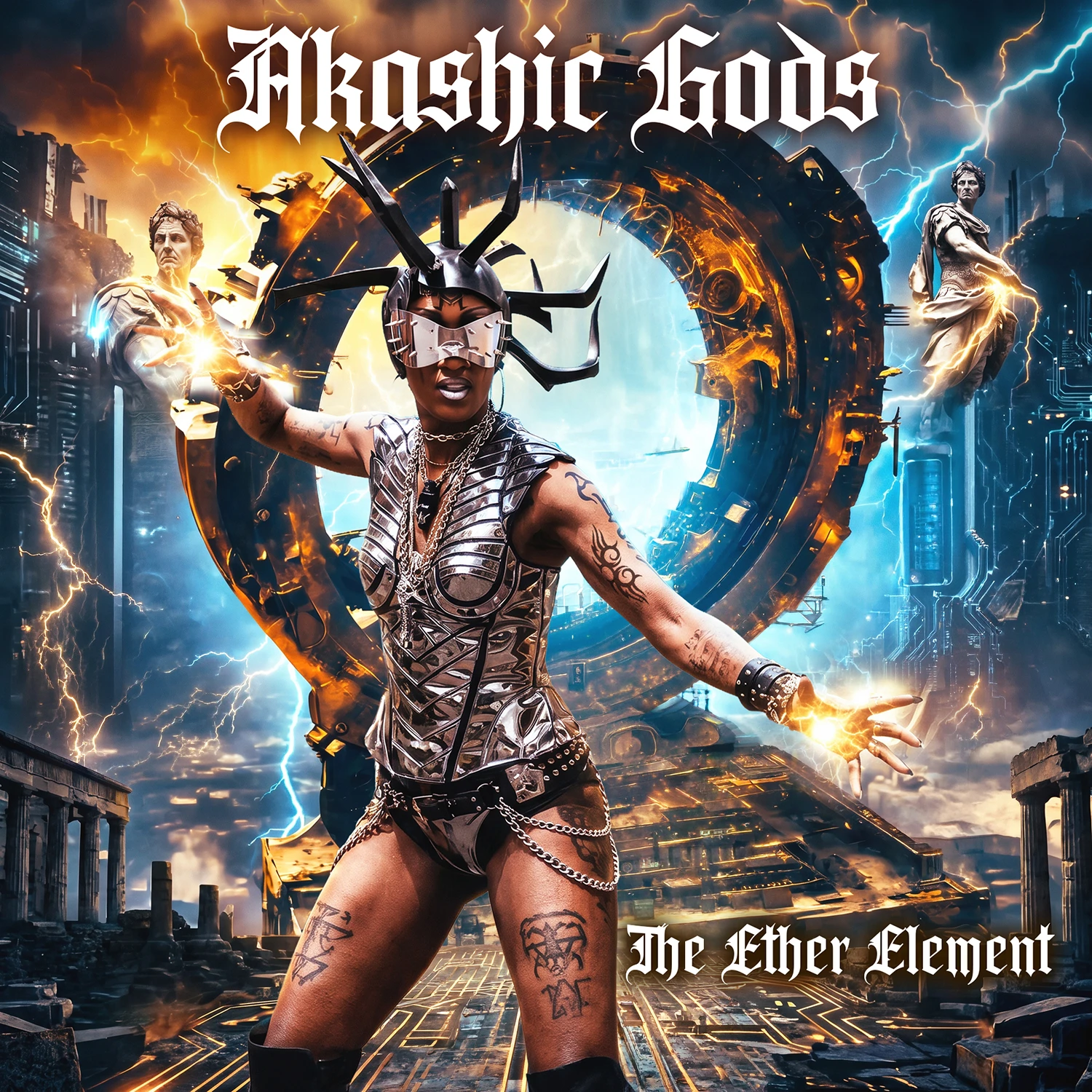
“Orphans of Wisdom” makes the case more directly. The track borrows the biblical warning that people perish for a lack of knowledge and pairs it with Socrates’ admission that all he knew was that he knew nothing, plus a nod to Alexander Pope on fools rushing in where angels fear to tread. AKASHIC GODS frames online arrogance as the newest version of a very old problem, describing a swarm of screen-addicted tech titans who have traded virtue for silver screens and data streams. The verses stay tight and claustrophobic before the chorus opens out, a structure meant to mimic being stuck behind a screen and then getting out from behind it.
The preoccupation keeps resurfacing in different costume. “Weapons in Space” describes a numb society as sleeping satellites drunk on vanity and screen glare, dragging apocalyptic imagery into fast, distorted punk territory. “Live Your Epitaph” goes after the habit of killing time with fantasy, reinforcing that a life spent deferring to tomorrow is a life spent on autopilot. “Ancient Civilians,” the closer is a war track about technological advancement running alongside moral regression, asking what bombs could possibly know of a golden age. After a first full listen, Josh Robinson, CEO of LMSUK, the marketing agency working the album, said the album was “SO good” that he was “in shock,” while naming “Surf the Future” as his favourite of the ten.
AKASHIC GODS is candid about wanting the record to work as an intervention. “In a culture that constantly feeds us a loop of digital noise, outrage, and distraction, leaving us as ‘orphans of wisdom,’ this album is designed to act as an immediate circuit-breaker,” she says, adding that she wants the music to shock people out of tech-driven hypnosis. By introducing an immersive vocabulary filled with empires of lies, bleeding edge of the web, and cybernetic matrices, the album ensures that listeners who come for raw guitar grit stay for a thought-provoking philosophical awakening—bridging stadium-sized rock power with a brilliant, multi-layered spiritual manifesto.
What keeps the record so gripping is its absolute specificity. The core message here is not a simple rejection of technology, but an intentional exposure of how human attention has been quietly outsourced to an automated hivemind, and the songs keep returning to the mechanics of how that trade happens. The Ether Element arrives this August with “Bring in the Elohim” as its focus single and the official music video dropping alongside. Its central claim is one Socrates got to first. Knowing everything and understanding nothing are not the same thing as wisdom, and the orphans in the title made that swap themselves.
AKASHIC GODS can be found on Instagram, Spotify, Facebook, TikTok and X.
Listen to the Ether Element album on Spotify.
To explore more of AKASHIC GODS’ earlier work, creative development and the technology-and-war themes behind “Weapons in Space,” visit this Just News International profile.
Album artwork by DesignerAde Ltd.


Beast Put a 15-Metre Céline on a Ruined Farmhouse

Serag Baddar Built An Entire Song Out Of The Parts Most Metal Bands Use As A Breather

Vanessa Béjine Takes Best Christian Song at the Hollywood Independent Music Awards

AKASHIC GODS Shatters Digital Hypnosis with an Arena-Sized Spiritual Awakening on ‘The Ether Element’

ONY Returns With ‘Take My Hand’ as He Builds Toward a New Album

Dave Curl Takes His Guitar to a Volcano for the New Single “Julia”

Why Silverstar Oh’s MELT BUSAN Set Deserves Attention

Ninety Seconds of Truth and Why “Chosen One” Is the Perfect Introduction to D$AVAGE

Project Rod Williams Wants You to Step Into Its Cyborg World

Lord Conrad Builds a House Anthem Around Dreaming Big on ‘Be Yours’

Lofi Bug Records Is Building A Massive Free Sample Library So Producers Stop Paying To Make Beats

aSellingSecrets: Building Real Amazon Businesses for Long-Term Growth

How Generator Engineer and Army Veteran Benjamin Irvine Built NeuroKnights to Teach Kids About Their Brains

When Lord Conrad Becomes the Hero of His Own AI-Generated Universe

Boris Volodarsky Spent Decades Studying Spies, Now He’s Making Movies About Them

Jason Luv Dominates Charts While Inspiring New Wave of Multi Career Artists

Harley West | Inside the Mind of a Social Media Star on the Rise

Raw Fishing | Franklin Seeber, Known As “Raww Fishing” Youtuber Story

Jordana Lajoie Transforms Montreal Roots into Hollywood Success Story

A New Hollywood Icon Emerges in Madelyn Cline

Who is Isaiah Silva – The Story Behind The Music

Tefi Valenzuela Pours Her Heart into New Song About Breaking Free

Holly Valentine | Social Media Influencer & Star Success Story

Kaia Ra | Perseverance That Built a Best-Selling Author

Gearshift to Stardom: Nikhael Neil’s Revolutionary Journey in the Automotive Industry

Kate Katzman | Breaking Into Hollywood and Embracing Change

Thara Prashad | Singer Evolves to Yoga & Mediation Superstar

G FACE Releases His New Single “All up,” and It’s Fire

Tadgh Walsh – How This Young Entrepreneur is Making a Name for Himself

King Lil G | West Coast Hip Hop Genius Rises to Face With Ease
Tefi Valenzuela Pours Her Heart into New Song About Breaking Free
Kate Katzman | Breaking Into Hollywood and Embracing Change
Holly Valentine | Social Media Influencer & Star Success Story
Kaia Ra | Perseverance That Built a Best-Selling Author

Lil Ugly Baby XXX’s “Who?” – The Mixtape to Boost Your Playlist

Samuel Chewning Explains How Fitness Should Be A Personal Journey

-
 Business4 years ago
Jason Luv Dominates Charts While Inspiring New Wave of Multi Career Artists
-
 Entertainment3 years ago
Harley West | Inside the Mind of a Social Media Star on the Rise
-
 Culture4 years ago
Raw Fishing | Franklin Seeber, Known As “Raww Fishing” Youtuber Story
-
 Culture3 years ago
Jordana Lajoie Transforms Montreal Roots into Hollywood Success Story
-
 Culture2 years ago
A New Hollywood Icon Emerges in Madelyn Cline
-
 Entertainment2 years ago
Who is Isaiah Silva – The Story Behind The Music
-
 Entertainment3 years ago
Tefi Valenzuela Pours Her Heart into New Song About Breaking Free
-
 Business4 years ago
Holly Valentine | Social Media Influencer & Star Success Story